• Skip to primary navigation
  • Skip to main content
  • Skip to footer
Exceed Investments

Exceed Investments

Let us be your Options Expert

  • Why Exceed
  • Strategy Spotlight
  • Who We Are
  • Blog
  • Contact
  • Login

investing

Nervous About Your NVDA Gains? A Solution to Both Protect and Participate with No Cash Outlay

NVDA has been one of the biggest beneficiaries of the recent AI craze, as the company has added 90% to its market capitalization year-to-date and a staggering 251% year-over-year. It’s now the third-largest company in the world with a market cap of about $2.4T, trailing only AAPL ($2.6T) and MSFT ($3.2T). If you or a client have been fortunate enough to ride this rally, you’re likely very pleased by the recent performance but also potentially have excess exposure to shares of this single, volatile company. As we’ve discussed in previous blogs, companies with the highest market capitalization have historically underperformed broad-market indices over longer timeframes. 1https://exceedinvestments.com/where-are-those-top-10-companies-now-nineties-focus/ 2https://exceedinvestments.com/where-are-those-top-10-companies-now-millennium-focus/ 3https://exceedinvestments.com/where-are-those-top-10-companies-now-2010-focus/ This isn’t to say that NVDA is going to underperform the broad market going forward, but history has shown that the upside outliers are scarce.

As a shareholder of a now-concentrated NVDA position, an investor faces the tradeoff of holding a portfolio with elevated embedded volatility that is exposed to greater downside risk versus selling a portion of their NVDA holding to diversify into a balanced market portfolio. However, rebalancing out of a highly-appreciated stock will likely come at the cost of a big tax bill. Thankfully, there is a solution using options that allows investors to hedge downside risk while also participating in significant potential share appreciation, and greatly reducing volatility while deferring and seeking to minimize capital gains taxes.

A collar is an option overlay strategy that involves selling an upside call against an existing stock position and using the proceeds from that sale to purchase protective puts that limit downside to a predefined level. A “zero-cost collar” is one of the more popular option strategies and involves matching the premium collected from the sale of the call to the cost of purchasing puts, thus requiring no or very little cash outlay, inclusive of the cost of executing the trade. There is an implicit cost of potential foregone upside in the event the stock rallies above the sold call option strike, but collars can even be structured as a net credit to the investor if so desired, resulting in a cash inflow.
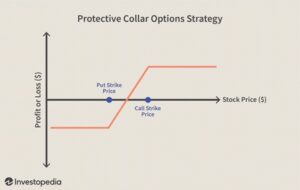


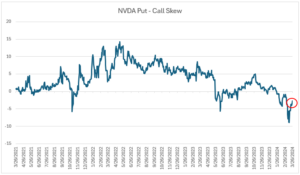
Option prices are dynamic and are partially driven by demand for bullish exposure (calls) versus bearish exposure (puts). When stocks rally sharply, calls are generally more “expensive” relative to puts because of excess investor demand to buy those calls and place bullish bets on continued appreciation. Contrarily when stocks sell off sharply, investor sentiment can shift dramatically and drive excess demand for put options. This is known as skew and is a common metric followed closely by option traders. The recent sharp rally in NVDA has driven call prices significantly higher than puts, creating the potential to use a collar overlay on an NVDA stock position very efficiently. At this point in time, you can sell very “expensive” calls and buy relatively “cheap” put options, maximizing the tradeoff between potential upside appreciation and downside protection via option collars. The chart below depicts the difference in implied volatility of calls versus puts, with the difference in implied volatility of 25-delta (out of the money) options plotted on the Y-axis. When the reading is positive, puts are relatively more expensive than calls, and when the reading is negative calls are more expensive than puts. The put-call skew reading hit an extreme low a couple weeks back, indicating that calls were at their most expensive level relative to puts at any point over the past three years. While this extremely low reading has reverted somewhat higher since then, the current level remains well below long-term averages.


NVDA closed at 925.61 on 3/26, and the options market has a volatility expectation of +/- 43.4% for NVDA shares between now and June 20, 2025, 450 days from today.4Using the midpoint of 6/20/25 option prices as of the market close on 3/26/24 for an at-the-money straddle This means that the options market is currently pricing NVDA to close within a range either 43.4% higher or lower from here, or between about 524 and 1327 by 6/20/25. Options can often be wrong about the realized volatility over a period, but we like to use this as a baseline expectation of outcomes over a certain timeframe to give a general idea how to best structure these trades.

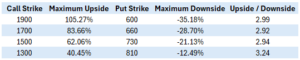
Assuming the options market is correct about its volatility expectation, you can currently sell the 6/20/25 1340-strike call on NVDA for about $110 per contract and buy the 790-strike put for about the same price. What this means is that a holder of an NVDA stock position with this collar overlay can fully participate in 44.8% share upside between now and 6/20/25, while limiting downside risk to a maximum of 14.7%. Perhaps the investor would like a little more upside potential and less downside protection or vice versa – below is a list of currently available collars that can be implemented at close to zero cash outlay. These strategies are fully customizable, so the NVDA holder can choose exactly how much potential upside or downside protection they desire and structure the trade accordingly. As you can see, the potential upside is generally a multiple of maximum downside by about a factor of 3 – this is a result of the excessive skew in NVDA call options that currently exists.


Options trading is nuanced and complex, with the opportunities that exist largely a product of the market environment. Recent trends in NVDA options have created what we view as a compelling opportunity for an investor currently sitting on a concentrated NVDA position. This collar overlay will significantly reduce volatility, allow the holder to still participate in some level of potential appreciation, and defer having to rebalance the portfolio and pay capital gains taxes. Contact us for a consultation as to how you can use the recent developments in the NVDA options market to your advantage.


IMPORTANT DISCLOSURE: The information in this blog is intended to be educational and does not constitute investment advice. Exceed Advisory offers investment advice only after entering into an advisory agreement and only after obtaining detailed information about the client’s individual needs and objectives. No strategy can prevent all losses or guarantee positive returns. Options trading involves risk and does not guarantee any specific return or provide a guarantee against loss. Clients must be approved for options trading at the custodian holding their assets, and not all retirement accounts are permitted to trade options. Transaction costs and advisory fees apply to all solutions implemented through Exceed and will reduce returns.

 

The Effect of Rising Interest Rates on Option Strategies

In 1973, economists Fischer Black and Myron Scholes published “The Pricing of Options and Corporate Liabilities,” which was the birth of the modern option pricing model that is still today’s gold standard for valuation. The formula isn’t perfect and has some limitations, but for the most part it’s withstood the test of time. We’re not going to get too into the weeds with the complex mathematical formula that they created, but if you want to learn more about it you can here.


What’s important to glean from the Black-Scholes Model are the factors that have a first-order effect on option prices and the extent of how changes in those inputs alter the underlying option price. There are 5 basic inputs that determine the price of an option:

  1. Underlying Asset Price – The price of the stock, index, or ETF. Higher-priced assets generally have higher option prices on a dollar basis (but not a percentage basis).
  2. Implied volatility – The market’s expectation of the future volatility of this asset1Not to be confused with historical volatility, which measures how volatile a security has been in the past. Many people use a combination of historical volatility, upcoming known events, and general market activity to triangulate a reasonable implied volatility estimate. . Higher expected volatility leads to higher option premiums and vice versa.
  3. Time to Expiration – The greater the time to expiration, the higher the theoretical price of an option (wider range of outcomes over longer timeframes), all else equal.
  4. Option Strike Price – The price at which the security can be purchased (call option) or sold (put option) by the option holder prior to or at the maturity date (expiration date)2We are assuming a US readership. “American” options can always have their right exercised while “European” options can only be exercised at maturity..
  5. The current Risk-Free Interest Rate3Dividends are incorporated into this rate – risk-free interest + dividend yield creates an effective forward rate for an underlying security. A hard to borrow security would result in a higher borrowing cost, which would affect the forward rate. This cost is also incorporated into the “rate” component of the formula. – Theoretical rate of return that an investor would expect on an investment with zero risk. The proxy for this rate is the yield of a Three-Month U.S. Treasury Bill.


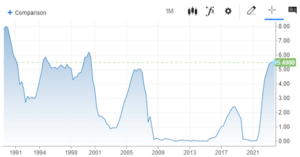
Many option traders are very familiar with 1-4 on this list, but the interest rate component is oftentimes ignored. It’s no secret that rates have risen dramatically over the past two years, especially at the short end of the curve.  The graph below depicts the 3-month U.S. Treasury Yield going back to 1990. The rate of ascent from the bottom in rates in early 2022 to present day is the fastest ever, and the current yield of 5.49% is near its highest level over the past 23 years.


All else equal, a higher risk-free interest rate leads to higher call option prices and lower put option prices.  Buying options is a way to get leverage and requires less initial investment than owning or shorting shares, though an option buyer must recognize the risk that they may lose all their investment if the underlying security is not above the call strike or below the put strike on the day of maturity. An investor can purchase call options instead of shares to express a bullish view and then use the difference in capital required to invest elsewhere. With interest rates much higher now than they were in early 2022, the opportunity cost of buying shares has increased. Money that would be tied up owning stock can now be invested “risk free” at more than a 5% return. We see the opposite of this phenomenon with put options – traders can buy put options to express a bearish view instead of shorting shares, but shorting stock becomes more profitable as interest rates increase. When you short a stock, the broker will pay interest on the cash that the short sale generated. Since the potential interest earnings are now much higher than before, put options become less valuable.


Let’s look at a hypothetical situation involving stock XYZ. We’ll assume that (1) the stock is $100 per share, (2) the strike price of both the call and put option are 100(at the money), (3) the options expire in 90 days, (4) the company doesn’t pay dividends, and (5) the volatility of XYZ shares is 20%. The risk-free rate in January 2022 was around 0.053%, so we’ll use that as a baseline.  Given those inputs, the theoretical call price is 3.97 and the put is 3.95.


Now let’s assume that nothing has changed except it’s now 10/31/23 and the risk-free rate is 5.49%. Using those inputs, the theoretical call price becomes 4.65 and the put is 3.41 – a 17% increase in the call option price and nearly a 14% decline in the value of the same put option!


Let’s take this a step further and look at out-of-the-money options, which are more rate sensitive than at-the-money options. Using the same assumptions as before and looking at 10% and 20% out-of-the-money options instead of at-the-money options, the changes in the option prices were staggering. The theoretical price of the 10% out-of-the money call rose by 27% and the 20% out-of-the money call rose by 39% merely from the difference in the risk-free rate between January 2022 and now.  Additionally, the price of 10% out-of-the-money put option declined by 23%, and the 20% out-of-the-money put saw a theoretical drop of 34% by adjusting only one variable. All else equal, the farther out of the money an option is, the more its value is affected by changes in interest rates.


Investors can capitalize on these recent market trends and use them to their advantage. It may not make as much sense now as it did in January 2022 to buy a call option (for multiple reasons), but you can flip that dynamic and use the elevated premiums to write covered calls and generate additional income on your stock holdings. With lower relative put premiums now than in 2022, hedging stock positions via buying puts or collars may be more logical now than before.


Options trading is nuanced and complex, with the opportunities that exist largely a product of the market environment. The dramatic spike in interest rates over the past couple years has changed the landscape and creates the potential for higher income generation and lower hedging costs now than before. Contact us for a consultation as to how you can use these developments to your benefit.


IMPORTANT DISCLOSURE: The information in this blog is intended to be educational and does not constitute investment advice. Exceed Advisory offers investment advice only after entering into an advisory agreement and only after obtaining detailed information about the client’s individual needs and objectives. No strategy can prevent all losses or guarantee positive returns. Options trading involves risk and does not guarantee any specific return or provide a guarantee against loss. Clients must be approved for options trading at the custodian holding their assets, and not all retirement accounts are permitted to trade options. Transaction costs and advisory fees apply to all solutions implemented through Exceed and will reduce returns.

The Power of Using Options in Retirement Accounts

At first glance, you might be thinking I’m insane to even be mentioning options and retirement accounts in the same breath. After all, options are meant for rampant speculation and are super risky, right? While they can be used for “gambling” purposes if so desired, options are flexible instruments that have a wide variety of uses and benefits, even in qualified retirement accounts such as an IRA.

The main benefit of investing in an IRA is that taxes are either deferred until the money is withdrawn (traditional IRA), or the account can be funded with after-tax dollars and grow over time without accruing any tax liability (Roth IRA). I won’t get into the details too much here, but Roth IRAs generally aren’t available to high-income households, though there are some workarounds. What’s important to note is the potential power of tax deferral and the effect that it can have on a retirement portfolio. This benefit is amplified when using an income-generating strategy such as writing covered calls against existing stock holdings.

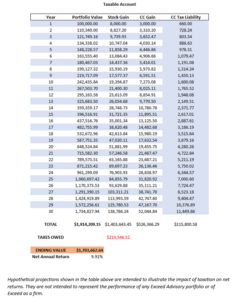
Consider a hypothetical portfolio of $100,000 that’s fully invested in equities. Let’s assume, to illustrate the math, that this portfolio returns 8% every year for 30 years, there are no annual contributions, and the investor implements a covered-call overlay strategy that generates an additional 3% annually in yield. The yield-generating potential of each portfolio depends on the volatility of its holdings, but we think 3% annual yield via covered calls is a conservative assumption. We’ll also assume that this investor is married and sits in the 22% tax bracket, which indicates a total household income range of $89,450 to $190,750 for 2023. For simplicity’s sake, we’ll also assume that no stock holdings are sold at any point until the end of this 30-year period. Lots of unrealistic assumptions here-especially the lack of volatility, which is obviously significant in the real world-but the simplicity helps make the point about the effect of taxes, since that’s the only factor that differs in the three scenarios shown.  Here’s what the growth of this hypothetical portfolio would look like over time. The “Portfolio value” column is a beginning of year number.

Profits from covered calls are taxed as capital gains, and in this example the tax rate is 22%. This tax liability is subtracted from the portfolio value every year and is a drag on the effects of compounding. The stock gain at the end of this 30-year period is taxed at 15%, the long-term capital gains rate for married couples earning $89,251-$553,850 annually. While this hypothetical investor accumulated significant wealth over this period, the taxes due each year from the covered-call returns were a drag on total returns.

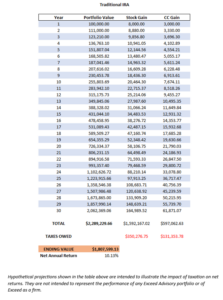
Now let’s look at the numbers had this $100,000 originally been held in a traditional IRA. The assumptions remain the same as the example above in the taxable account, but the tax treatment is different. In a traditional IRA, all taxes owed are deferred until retirement, which we’re assuming is in 30 years. The tax rate on all gains in a traditional IRA is the income tax bracket that the investor resides in, which in this case is 22%. Both the stock and dividend profits will be taxed at 22%, but not until the end of this thirty-year period.

The deferred tax treatment in this case led to an additional net return of 0.22% annually. While this doesn’t seem like much on the surface, this can be significant over 30 years. In this example, that equated to an additional $103,936 in portfolio value! This amount would be even greater over a longer time horizon, or if the assumed returns were higher.

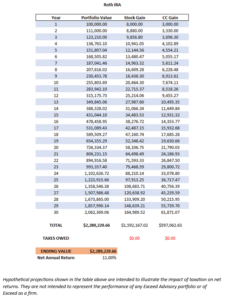
Lastly, let’s look at the numbers if this hypothetical portfolio was in a Roth IRA. Roth IRAs allow for all gains to grow tax free. The drawback to Roths is that there are annual contribution limits, income requirements, and if you roll an existing retirement account into a Roth IRA, you’ll likely owe income taxes on that money at inception. Most retirement accounts are funded with pretax dollars whereas a Roth IRA is funded with post-tax dollars. However, once this one-time tax is paid, you’ll never have to pay another penny in taxes on that account, assuming the appropriate rules are followed.

As you can see, the effect of not having to pay annual or terminal taxes on this account is substantial. An additional 0.87% net return annually (via tax savings) from a Roth IRA versus a traditional IRA equated to $481,631 more in portfolio value at the end of this period. This is a great example of how being tax savvy at the margin can have a dramatic effect on wealth as time goes on.

Retirement accounts aren’t generally where you see option activity, but small return enhancements over time can really add up. Using a covered-call overlay strategy inside of a tax-advantaged account can reduce volatility, potentially increase returns on both an absolute and risk-adjusted basis, and have a significant effect on retirement wealth.


IMPORTANT DISCLOSURE: The information in this blog is intended to be educational and does not constitute investment advice. Exceed Advisory offers investment advice only after entering into an advisory agreement and only after obtaining detailed information about the client’s individual needs and objectives. No strategy can prevent all losses or guarantee positive returns. Options trading involves risk and does not guarantee any specific return or provide a guarantee against loss. Clients must be approved for options trading at the custodian holding their assets, and not all retirement accounts are permitted to trade options. Transaction costs and advisory fees apply to all solutions implemented through Exceed and will reduce returns.
Footer

Get in Touch

  • 79 Madison Avenue 3rd floor,
    New York, NY 10016
  • 646-580-7046

Legal

  • Privacy Policy
  • Terms and Conditions
  • Disclosures

Recent Posts

  • Box Spread Lending: A Tax-Efficient Way to Leverage Investment Portfolios
  • The Psychology of Waiting – Why Investors Delay Hedging Until It’s Too Late
  • Why Options Strategies Belong in Portfolios with Concentrated Positions

Copyright © 2025 · Exceed Investments · Web Design Services by JSMT Media